


There are no non-essential devices in the enterprise. Even common belt conveyors, also known as conveyors, significantly influence production automation. Modest but powerful mechanisms silently move the company forward. They speed up production and improve efficiency . This is why, although their role in the company is often underestimated, it is worth taking a closer look at how industrial transporters influence the process of automating the production line . In the article below, we will discuss their use and advantages, as well as tell you what to pay attention to when choosing transporters and how to adapt them to the production method. Finally, we will also recommend proven and reliable industrial belt conveyors. We invite you to read more!
Spis treści
Industrial transporters – the most important information
Belt conveyor, industrial conveyor, in colloquial usage, conveyor belt (although the latter term means several belt conveyors connected into one string) – regardless of the term used, its essence remains the same. This device is so common that it would seem there is no need to talk about it. And yet… in the era of automation of production processes , the belt conveyor is one of the key elements to make the entire process effective.

Horizontal belt conveyor by Virginio Nastri
Initially, belt conveyors were most often used in the mining and construction industries, for transporting spoil in mines or aggregates on construction sites. However, their advantages were quickly appreciated in the industry for mass production of various types of goods , including plastic elements. While the production of small plastic elements is possible without this device, and the products may fall loose into the container under the machine, it must be admitted that production using an industrial conveyor is much more aesthetic, efficient and safe. In addition, new generation machines allow the device to be adapted to a given production in terms of:
- transporter design,
- tapes and protection used,
- transporter housing,
- additional elements.
What should you pay attention to when choosing belt conveyors?
The selection of a belt conveyor depends largely on the nature of production, the detail produced, the design of the machine, etc. For example, a foldable inclined conveyor is ideal for production when small, light elements can fall directly from under the machine onto the conveyor placed underneath it after opening the injection mold. The details come out from under the machine and are transported higher to the operator or straight to the packaging. Often the tape is equipped with the so-called flights so that the details do not slide down the belt. For very small details, it is also worth equipping the belt conveyor with a corrugated side . This solution prevents manufactured elements from getting between the belt and the conveyor housing.

Inclined conveyor by Virginio Nastri
Moreover, if sprue branches also fall onto the conveyor belt along with the details, there is also a way to fix this. You can use an ingot separator in the version that will work best in the separation process.

Paddle ingot separator
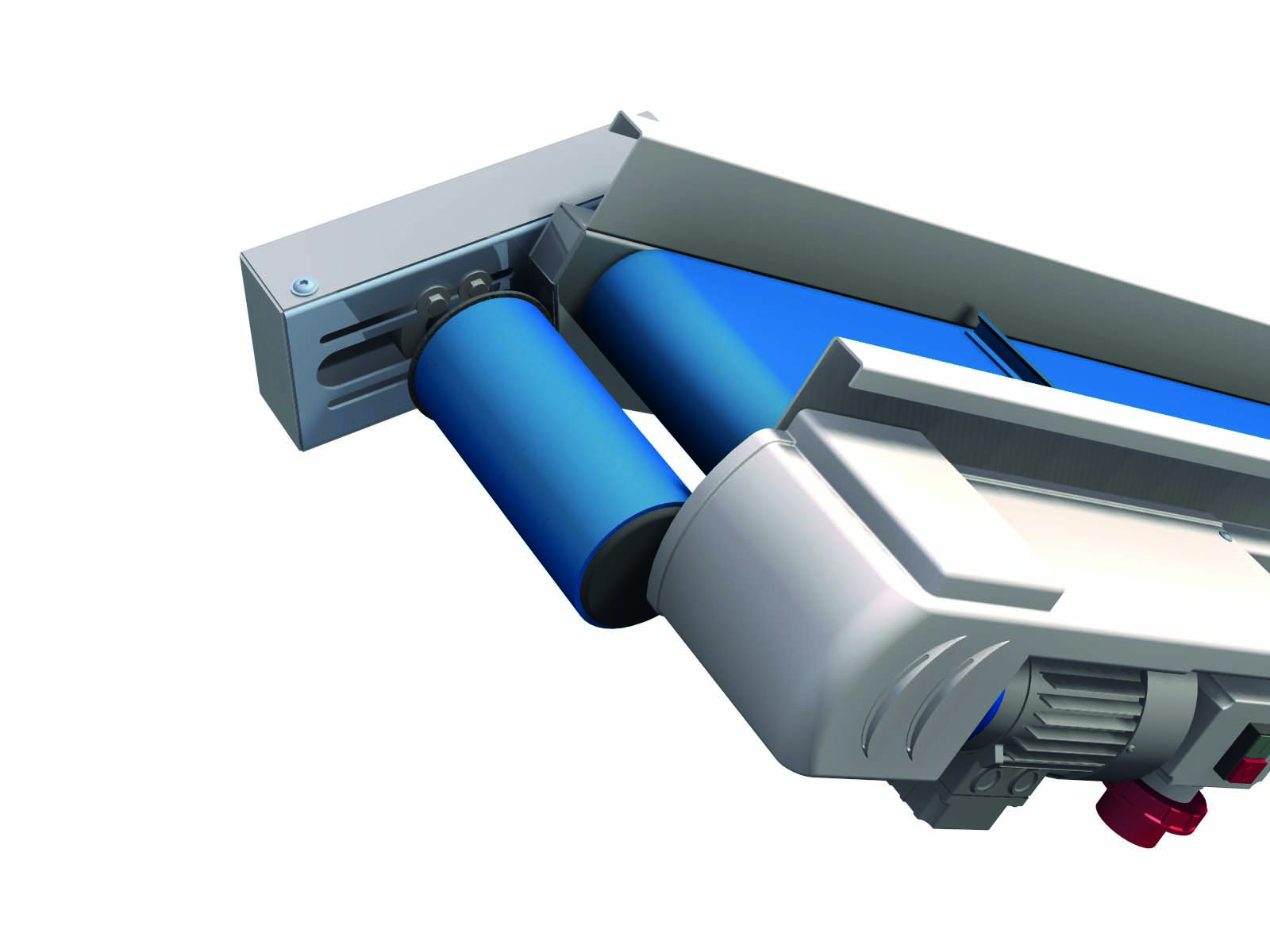
Roller ingot separator
In the case of larger machines and plastic elements that must be handled gently due to their size or risk of scratching, flat conveyors are used. Then, most often, the details are placed on the conveyor by a Cartesian or industrial robot. Details can be placed in stacks on an industrial conveyor, which are then moved towards the operator or another packaging robot. In such a situation, it is important for the machine to cooperate with the robot and the belt conveyor so that the process runs at the appropriate pace and without disruptions.

Horizontal conveyor by Virginia Nastri
If you have more questions about transporters or need specialist advice – contact:
- Emilia Sikora (West Pomeranian Voivodeship, Pomeranian Voivodeship, Kuyavian-Pomeranian Voivodeship, Warmian-Masurian Voivodeship), e-mail: sikora@dopak.pl , tel. +48 519 537 757
- Ilona Bazgan (Lubuskie, Wielkopolskie, Łódź, Masovian and Podlaskie Voivodeships), e-mail: bazgan@dopak.pl , tel. +48 509 765 325
- Kajetan Danko (Lower Silesian, Opole, Silesian Voivodeships), e-mail: danko@dopak.pl , tel. +48 509 857 229
- Patryk Barski (Lubusz Voivodeship, Świętokrzyskie Voivodeship, Małopolskie Voivodeship, Podkarpackie Voivodeship), e-mail: barski@dopak.pl , tel. +48 519 537 751
Which industrial conveyors should you choose for production automation?
Do you care about production automation? Are you wondering what devices will be suitable? Choose industrial transporters manufactured by the Italian company Virginio Nastri offered by DOPAK. These are devices of excellent quality, known on the market for many years and appreciated by customers. In addition to a wide range of standard transporters, it is also possible to produce transporters dedicated to specific customer needs. The offer includes flat conveyors for automatic work with a robot, single or double inclined conveyors, and conveyor systems that allow the transfer of products to subsequent operating cells of the process.
Standard belt conveyors are made of universal, painted steel frames with a modular structure. In turn, the great advantage of Virginio Nastri inclined conveyors is the solid adhesion of the tape and the sealing of the walls, which prevents small elements from jamming. Also important is the easy and quick adjustment of the height and angle of inclination , which is provided by the telescopic leg system available in two installation versions. The belts in Virginio Nastri belt conveyors are made of three-layer PVC or PU, a material resistant to impact and high temperature.
Virginio Nastri devices offered by DOPAK will prove useful in an automated production line, especially if it requires special applications, e.g. separation of ingots, conditioning of parts in water or sorting of parts.
At the customer’s request, the manufacturer can make a dedicated conveyor with the required parameters and dimensions, which will directly translate into increased efficiency and quality of the processes.
DOPAK’s offer also includes other peripherals for plastics and machines for plastics processing . Thanks to this, you can buy everything you need to automate production processes in one place.
Author: Emilia Sikora, Regional Sales Manager, tel. +48 519 537 757, e-mail: sikora@dopak.pl
Read also:
Drum, roller, paddle or vibrating separators – which to choose and why?


