


Plastic peripherals play an extremely important role on the production floor. One particularly useful piece of equipment is a granulate feeder . It affects the smoothness of plastic dosing, the quality of the final product and production efficiency. What is a granulate feeder? How does it work and what are its uses? Below we will discuss these issues and explain what to consider when choosing one.
Spis treści
What is the granulate feeder used for?
Granule feeders are devices used in industries focused on the processing of plastics. Their main task is to supply the appropriate amount of granulate to the processing machine, e.g. injection molding machine, extruder, blow molding machine, dosing system. Feeders for plastics most often work on the principle of vacuum, and there are two types of feeders: single-phase and three-phase. Single-phase vacuum feeders have a built-in small turbine that generates a vacuum. In turn, three-phase feeders cooperate with a separate vacuum generator. Single-phase feeders are the most commonly used in production plants . Mainly due to the low investment cost, simplicity of operation and compact dimensions. However, they have several drawbacks – higher susceptibility to disturbances and failures of the turbine system, higher maintenance and cleaning costs required, relatively low efficiency and limitations in transport distance. System feeders do not have all of the above shortcomings. Additionally, they have specific advantages that are difficult to achieve with single-phase feeders. They are designed for a wide range of performance and feeding distances, can be modified depending on the user’s changing requirements, automatically clean the transported granules from dust, and do not have sensitive electrical and electronic components. System feeders are used primarily in central granulate feeding systems. However, more conscious and demanding users also choose these devices for feeding to single processing machines.
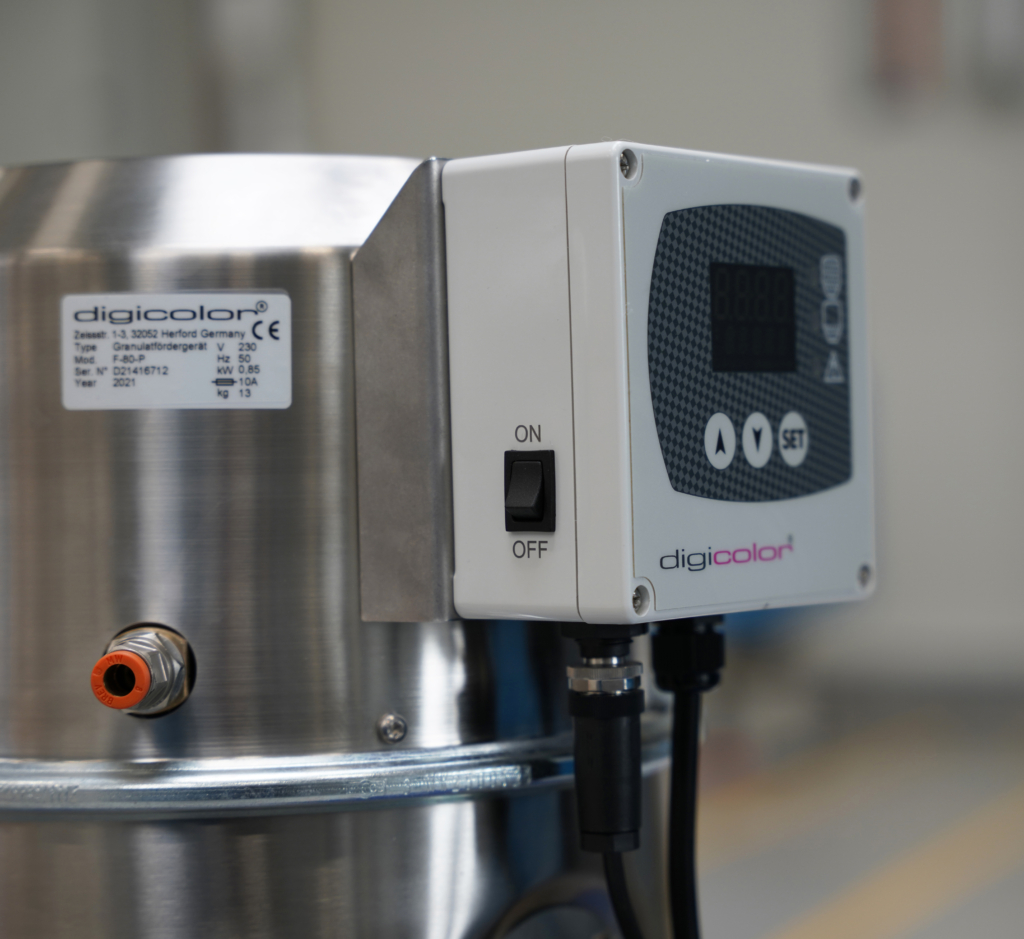
Why is it worth choosing a system with feeders?
Why are pellet feeders key elements in a plastic-based production process? First of all , they ensure stable and automatic material feeding , which has a significant impact on production efficiency and the degree of production automation. This also allows for uniformity and repeatability of manufactured products. Plastic feeders are also a way to minimize losses and waste . Properly selected devices allow for almost maintenance-free production, which significantly improves production profitability rates and reduces personnel costs.
Granule feeders are the first level of automation of the manufacturing process . These devices are integrated with processing machines, such as injection molding machines, thanks to which it is possible to increase efficiency and shorten production cycle time. The feeders therefore enable a smooth and continuous flow of material. This solution has two more important advantages. Granule feeders allow you to eliminate human errors and increase employee safety.
How to choose a feeder for granules and plastics?
The selection of appropriate feeders is important for the effectiveness and efficiency of the industrial process. Therefore, before purchasing, you should consider various factors such as:
- fraction and dust level of plastic granules,
- injection process requirements – process parameters such as injection weight and cycle duration should be taken into account,
- design of the processing machine – the design of the feeder should be compatible and fit for installation on the machine,
- feeding distance and height,
- efficiency and performance – it is worth taking into account operating costs, energy consumption and feeder efficiency,
- safety and reliability – the feeder should be safe to use, easy to clean and maintain,
- scalability and flexibility – if possible changes in production are anticipated, it is worth considering a feeder that can be easily adapted to new requirements,
- technical support and service – the ability to use appropriate technical support or service is particularly important.

Plastic feeder in Dopak
Granule feeders bring many benefits, including smooth dosing, automation, minimizing losses and waste , increasing production efficiency, flexibility and cost optimization. Their selection and use in plastic processing processes contributes to improving the quality of products, shortening production time and increasing the competitiveness of the company. Therefore, it is worth choosing proven manufacturers who guarantee durable and high-quality solutions. When looking for granulate feeders , choose devices from the German company Digicolor , which are included in Dopak’s offer. You will find here:
- single-phase station feeders – F series,
- Venturi feeders, dedicated to feeding masterbatch to the dispenser
- three-phase system feeders – AT series,
- compact feeding systems.
These feeders are very solidly built, guaranteeing a long service life and resistance to difficult conditions during the production process. Want to know more details? Contact us! Check also other peripheral devices and plastic processing machines available in our offer!


